Monday, 3 January 2011

Medieval Greek

Medieval Greek, also known as Byzantine Greek,[1] is the stage of the Greek language between the beginning of the Middle Ages around 600 and the Ottoman conquest of the city of Constantinople in 1453. The latter date marked the end of the Middle Ages in Southeast Europe. From the 7th century onwards, Greek was the only language of administration and government in the Byzantine Empire. This former stage of language is thus described as Byzantine-Greek. The study of the Medieval Greek language and literature is a branch of Byzantine Studies, or Byzantinology, the study of the history and culture of the Byzantine Empire.

The beginning of Medieval Greek is occasionally dated back to as early as the 4th century, either to 330 AD, when the political centre of the monarchy was moved to Constantinople, or to 395 AD, the division of the Empire. However, this approach is rather arbitrary as it is more an assumption of political as opposed to cultural and linguistic developments. It is only after the Eastern Roman-Byzantine culture was subjected to such massive change in the 7th century that a turning point in language development can be assumed. Medieval Greek is the link between the ancient and modern forms of the language because on the one hand, its literature is still strongly influenced by Ancient Greek, while on the other hand, many linguistic features of Modern Greek were already taking shape in the spoken language.
Contents

Saturday, 1 January 2011

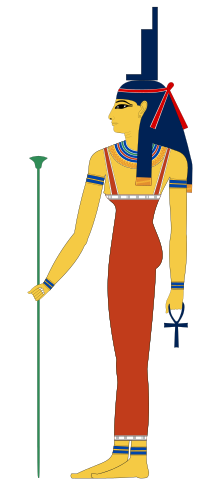
Isis is the goddess of magic and healing, wife of Osiris

 Isis (pronounced /ˈaɪ.sɪs/ or eye-sis) was a goddess in Egyptian mythology. She was the sister and wife of Osiris, and they had a son named Horus. Isis also protected children and was one of
 the greatest goddesses. She was also the greatest magician and goddess of magic.

 Origin of the name

The English pronunciation used, /ˈaɪ.sɪs/), comes from the pronunciation of the Greek name, Ίσις, which changed the Egyptian name by adding a final "-s" because of the grammatical requirements of Greek noun endings.

The Egyptian name was recorded as ỉs.t or ȝs.t and meant '(She of the) Throne'. However the true Egyptian pronunciation is not known because their writing system left out vowels. Based on recent studies, the reconstructed pronunciation of her name is *ʔŪsat (ooh-saht). Later, the name in Coptic dialects was "Ēse" or "Ēsi".

To make it easier to say, Egyptologists choose to say the word as "ee-set". Sometimes they may also say "ee-sa". This is because the last "t" in her name was a feminine (female) suffix which is known to have been dropped in speech in the last stages of the Egyptian language

Powers

Isis had great healing powers along with her being a magician and a protector. She could even cast spells on Ra. An example of her powers is when Isis brought Osiris back to life for one night. Though the powers of Isis are strong, there even things she could not do like she could only bring back Osiris to life for a night.

Thursday, 30 December 2010

Horus is the god with falcon's head, god of pharaohs and sky

Horus was a the Egyptian god of the Sky. He was the son of Isis and Osiris. After fighting his uncle Seth, he became the king of Egypt. During this fight, he lost his eye. The Eye of Horus became one of the most important symbols in ancient Egypt.
Contents

The Eye of HORUS

The Eye of Horus was a powerful amulet. It was a sign of protection. It was also called the Wadjet Eye. The ancient Egyptians worshiped Horus partly because he had the Eye of Horus.

Worship

Horus was considered handsome and usually appeared as a falcon or a falcon headed man, although sometimes he appeared as a falcon headed crocodile. Sometimes he would take the form of a celestial falcon with his left eye the moon and his right eye the sun, his speckled breast feathers the stars, the down sweep of his wings creating the winds. He is sometimes shown with a copper knife. In addition, he normally wore the double crown to signify his rule over all of Egypt and to relate with the Pharaoh.

Gods and goddesses of Egypt

Gods and godesses of Egypt were often represented as animals or other forces of nature.Here you can find list of gods and goddesses of egypt and the shape in which they were represented centuries ago.The information shown below is drawn from areceological foundings in Ancient Egypt.You can click the particular deity you are interested in to read article on wikipedia about Gods and goddesses of Egypt.

Ra is the eagle god of the sun and,he has a falcon head.
Anubis is the god of mummification
Bast is the Cat goddess.
Sehkmet goddess of fire, war and plague
Serqet is the goddess of scorpions
Nut is the goddess of sky and stars, mother of gods.
Geb is the green god of Earth, and vegetation.
Horus is the god with falcon's head, god of pharaohs and sky.
Osiris is the god of the afterlife.
Isis is the goddess of magic and healing, wife of Osiris.
Seth is the god of deserts and evil.
Thoth is the scribe god and the god of forethought, writing, and wisdom.
Ma'at is the goddess of truth.
Amun is the god of Thebes, king of gods in New Kingdom.
Wadjet is the goddess of pregnancy and motherhood, goddess in snake form.
Anuket is the goddess of river Nile.
Hathor is the goddess of the moon and children.
Ptah is the creator god
Bes is the dwarf god of safe journey
Sobek is the god of crocodiles.
Aten is the "king" of the gods

    Ancient Egyptian religion

    Ancient Egyptian religion was a complex system of beliefs and rituals which were an integral part of ancient Egyptian society. It centered on the Egyptians' interaction with a multitude of deities who were believed to be present in, and in control of, the forces and elements of nature. The myths about these gods were meant to explain the origins and behavior of the forces they represented, and the practices of Egyptian religion were efforts to provide for the gods and gain their favor.

    Formal religious practice centered on the pharaoh, the king of Egypt. Although he was a human, the pharaoh was believed to be descended from the gods. He acted as the intermediary between his people and the gods, and was obligated to sustain the gods through rituals and offerings so that they could maintain order in the universe. Therefore, the state dedicated enormous resources to the performance of these rituals and to the construction of the temples where they were carried out. Individuals could also interact with the gods for their own purposes, appealing for their help through prayer or compelling them to act through magic. These popular religious practices were distinct from, but closely linked with, the formal rituals and institutions. The popular religious tradition grew more prominent in the course of Egyptian history as the status of the pharaoh declined. Another important aspect of the religion was the belief in the afterlife and funerary practices. The Egyptians made great efforts to ensure the survival of their souls after death, providing tombs, grave goods, and offerings to preserve the bodies and spirits of the deceased.

    The religion had its roots in Egypt's prehistory, and lasted for more than 3,000 years. The details of religious belief changed over time as the importance of particular gods rose and declined, and their intricate relationships shifted. At various times certain gods became preeminent over the others, including the sun god Ra, the creator god Amun, and the mother goddess Isis. For a brief period, in the aberrant theology promulgated by the pharaoh Akhenaten, a single god, the Aten, replaced the traditional pantheon. Yet the overall system endured, even through several periods of foreign rule, until the coming of Christianity in the early centuries AD. It left behind numerous religious writings and monuments, along with significant influences on cultures both ancient and modern.

    Noria hama

    نواعير حماه
    A noria (Arabic: ناعورة‎, nā‘ūra, from Syriac: ܢܥܘܪܐ, nā‘urā) is a machine for lifting water into a small aqueduct, either for the purpose of irrigation or, in at least one known instance, to feed seawater into a saltern.

    There are three types of noria. The most common examples consist of a vertical wheel which is slung with a chain of buckets. The buckets hang down into a well which may be up to 8 m (26 ft) deep. The most primitive norias of this type are driven by donkeys, mules, or oxen. The animal turns another wheel, which is engaged with the noria and so causes it to turn. This causes the buckets to circulate.

    A second type of noria uses the same system, of a necklace of clay or wooden buckets, but it is driven by the wind. The wind driven norias in the vicinity of Cartagena, Spain, are virtually identical in appearance with the local grinding mills.

    The third type of noria uses the energy derived from the flow of a river. It consists of a large, very narrow undershot waterwheel whose rim is made up of a series of containers which lift water from the river to a very small aqueduct at the top of the wheel. Unlike the water wheels found in mills, a noria does not provide mechanical power to any other process. Its concept is similar to the modern hydraulic ram, which also uses the power of flowing water to pump some of the water out of the river.[1]

    A few norias were hybrids, consisting of an animal-driven waterwheel.

    A noria can raise water to somewhat less than its full height. The largest noria in the world, with a diameter of about 20 meters, is located in the Syrian city of Hama.

    It performs a similar function to chain pumps (including the saqiya), and other pumps, that of moving water from a lower elevation to that of a higher elevation, but these are generally powered by other means, not by a waterwheel).
    Sound of a noria
    صوت الناعورة
    http://upload.wikimedia.org/wikipedia/commons/e/e6/Hama-sound_of_noria.ogg

    Ancient Egypt

    Ancient Egypt
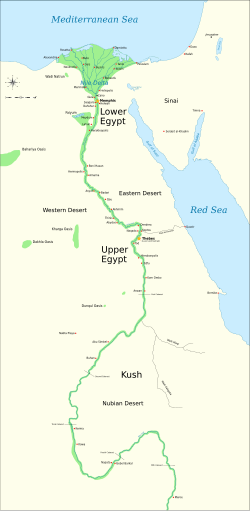
    Ancient Egypt was an ancient civilization of eastern North Africa, concentrated along the lower reaches of the Nile River in what is now the modern country of Egypt. It was part of a larger complex of civilizations, the Nile Valley Civilizations, of which regions south of Egypt (in today's Sudan, Eritrea, Somalia, and Ethiopia) are a part. Egyptian civilization coalesced around 3150 BC[1] with the political unification of Upper and Lower Egypt under the first pharaoh, and it developed over the next three millennia.[2] Its history occurred in a series of stable Kingdoms, separated by periods of relative instability known as Intermediate Periods. Ancient Egypt reached its pinnacle during the New Kingdom, after which it entered a period of slow decline. Egypt was conquered by a succession of foreign powers in this late period. The rule of the pharaohs officially ended in 31 BC when Egypt fell to the Roman Empire and became a Roman province.[3]

    The success of ancient Egyptian civilization stemmed partly from its ability to adapt to the conditions of the Nile River Valley. The predictable flooding and controlled irrigation of the fertile valley produced surplus crops, which fueled social development and culture. With resources to spare, the administration sponsored mineral exploitation of the valley and surrounding desert regions, the early development of an independent writing system, the organization of collective construction and agricultural projects, trade with surrounding regions, and a military intended to defeat foreign enemies and assert Egyptian dominance. Motivating and organizing these activities was a bureaucracy of elite scribes, religious leaders, and administrators under the control of a pharaoh who ensured the cooperation and unity of the Egyptian people in the context of an elaborate system of religious beliefs.[4][5]

    The many achievements of the ancient Egyptians include the quarrying, surveying and construction techniques that facilitated the building of monumental pyramids, temples, and obelisks; a system of mathematics, a practical and effective system of medicine, irrigation systems and agricultural production techniques, the first known ships,[6] Egyptian faience and glass technology, new forms of literature, and the earliest known peace treaty.[7] Egypt left a lasting legacy. Its art and architecture were widely copied, and its antiquities carried off to far corners of the world. Its monumental ruins have inspired the imaginations of travellers and writers for centuries. A newfound respect for antiquities and excavations in the early modern period led to the scientific investigation of Egyptian civilization and a greater appreciation of its cultural legacy, for Egypt and the world.[8]